Tuesday, January 08, 2019

Leaps and Rebounds Trampoline Review

I decided on which rebounder to get! I've had it for a couple of weeks now, so as promised, I will share what I think of it.

Why I Chose Leaps & Rebounds


I spent so much time browsing trampolines and reviews that my eyes grew blurry. I wanted to find a balance between affordable and well-made. In other words, I didn't want a rebounder that was going to fall apart in a year or two, but I also didn't want to throw money away on a popular brand name. So here's what drew me to Leaps & Rebounds:
  1. Price - It's under $200 even though it seems very similar to the expensive ones.
  2. Thicker Bungees - They seem thicker than other affordable bungee rebounders.
  3. Lifetime Warranty - This was ultimately what swayed me. They offer a lifetime warranty on the frame and mat. Other rounders only offer three months, or only cover the frame. The fact that they included the mat gave me confidence in their product.

Initial Impressions

The frame and legs seem thick and very sturdy out of the box. The bungees are crimped with metal rather than knotted by a plastic doohickey. I have no idea if that's better or not, but the bungees do seem very durable and strong. I like the pretty shade of green. I actually like all the vibrant colors they offer. It's nice to have a choice.

After assembly I immediately began jumping on it to test it out. The frame appeared to be solid and even, though there was the teeniest wobble if I went out of my way to shake it back and forth, likely due to tiny imperfections in the leg or rubber foot manufacturing. There's no wobble at all when it's on a rug.

Noise

I strayed away from metal spring rebounders since I am quite averse to unnecessary noise. I am quite pleased with how quiet this one is. It's not silent, mind you. There is friction noise from the bungees rubbing against the frame. I was bouncing gently on the trampoline one day (feet remained in contact with the mat) while someone was in another room. They told me it sounded like I was, um, getting it on with someone in bed. Ha! I suppose the difference is that it's a nice new bed, rather than a squeaky, 30-year-old bed. :D

Overall I'm satisfied with the noise level of this trampoline. It's reasonably quiet, and I can use it during movies without bothering the other viewers. Here's a quick little video of what it sounds like. You can hear the slight wobble when it's on hardwood floors, but it's absent on carpet. Note that the trampoline isn't enormous, but still big enough to allow room for you and your clingy dog.


What It's Like To Actually Use It

I like it! As noted above, I think it's the perfect size. It's fairly light. I can easily move it around the room, stand it on its side, and tuck it behind the couch. It can also stand on its own thanks to the legs. It doesn't have to lean against anything. And it doesn't feel so small that I'm afraid of careening off the thing while jumping. I've never been all that coordinated, so it's nice to not worry about that.

I like how bouncy it is. With subtle movements, I can initiate bouncing movements. I like to alternate between using my calves, my thighs, or just swinging my arms. Very little effort is needed, but after about five minutes, I can feel my heart rate elevating. It's easy to just get into a rhythm and not be conscious of what your'e doing, which is great when watching a movie.

The Leaps and Rebounds rebounder is rated at 249 pounds, I believe. In the video above, the person on the trampoline is about 200 pounds. You can see it's handling the weight like a champ. We both use the rebounder without issues, alternating between gentle bouncing and higher energy jumping. After two weeks of everyday use, no issues have come up.

I'm able to jump on this with bare feet, with socks, or with shoes. My feet do feel tired after bouncing on it a while, so I find it helpful to wear shoes with arch support sometimes.

Here's a summary of what I perceive are the pros and cons of the Leaps & Rebounds trampoline:

Pros

  1. Sturdy
  2. Quiet
  3. Affordable
  4. Lifetime warranty
  5. Good size / not heavy
  6. Nice and bouncy

Cons

  1. Assembly can be tricky the first time around (I'll write up a followup post on tips to make it easier. I assembled one for a friend recently, and it took me half the time, with fewer scrapes.)
  2. While the slight unevenness of one of the legs causes a bit more noise than I like on a hard surface, it's not really an issue since I use it on the rug in front of the TV.

Conclusion

Overall I am quite happy with this rebounder. Admittedly, this is the first one I've ever owned, so I can't really compare it to others. All I know is it satisfies all my requirements, and I would definitely recommend it to others. In fact, I took this to my mom's house to show her, and now she wants one too! Here are a couple more photos of the assembled trampoline:


Thursday, December 06, 2018

Which Type of Rebounder is Best?

There may not be just one best kind of rebounder, but I set out to research which one might be right for me. I discovered there are three primary kinds:

Elastic Bands
These are the cheapest trampolines you'll find. If it's under $80, chances are they use wide elastic bands, like an industrial version of the stuff you might find on some waistbands. From the reviews I've read on various models, these are great at first. Bouncy and invigorating like a rebounder should be Then, depending on frequency of use, they seem to degrade after about a year. The elastic bands rip, the mat gets warped and stretched out, and stitching unravels. The warranty on these things tends to be around three months.

Springs
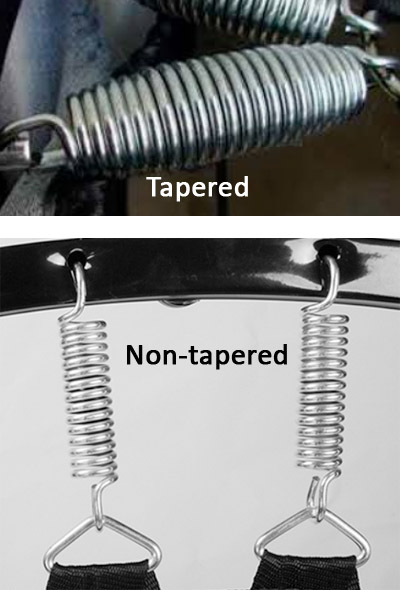
There are both high end and low end trampolines that use springs for the bounce. The springs on the low end ones are straight cylinders in shape, while the coils on the high end springs are tapered on both ends. You can see the difference here:


The theory behind the tapered shape is that it eases the bounce, allowing more give at first and then getting stiffer as the spring lengthens. This makes for a "bouncier" experience, while regular springs tend to be more jarring. The whole point of a rebounder is to make jumping low impact, so these cheap springs kind of defeat the purpose. Another thing to consider is spring-loaded trampolines tend to be noisy since it's metal moving against metal.

Bungees
These use a whole bunch of bungee cords instead of springs. Like springs, they come in expensive and inexpensive models. My guess is the price difference is in the materials used. Lower gauge metal frames and thinner bungees bring down the cost and quality of the trampoline. In all the videos I saw where users compared a bunch of different rebounders, they tended to favor the bungees. They offered a softer, quieter, "bouncier" bounce.


Round vs Hexagonal
Rebounders come in two shapes:  circle or hexagon. I saw these two types everywhere, yet there was no literature on the benefits of either shape. Why are there two kinds? I found one blog post that helped a little, and it basically said this: The hexagonal rebounder offers a bigger "sweet spot" for jumping springiness. On the other hand, round rebounders have a tendency to send the jumper back to the center if you stray off a little. That's the only difference I could uncover. In the end I decided shape was inconsequential and would not factor into my decision.

Conclusion
I really hate noise, so the noisiness of springs is a big turnoff for me. I don't know if all spring rebounders are noisy, but the high end ones are pretty expensive, so I will probably lean toward the bungees. I'm going to stay away from the elastic bands because I plan on sticking with rebounding for the long term. I don't wan the thing falling apart after only a year. I'll update here once I decide on which one to get.

Wednesday, November 28, 2018

Rebounding: Exercise For Lazy People

If you're anything like me, you know the importance of exercise, but still hate doing it. What's an informed-yet-lazy geek to do?

I recently learned about rebounding. I don't mean your boyfriend just broke up with you and now you're about to enter into an inappropriate relationship. Not that kind of rebounding. I'm referring to jumping on one of those fitness mini-trampolines.

Wait, don't roll your eyes yet! Let's talk about all the ways rebounding is so great, then you can judge.

Gets Your Lymph Moving
You remember the lymph system? Exercise in general will get those fluids moving, but the up-down movement of jumping is one of the most effective methods of all.

Increases Bone Density
NASA wanted to find a way to help astronauts regain the bone density they lost in space. (Moving around in space is so effortless that the body start losing bone mass.) They found that jumping on a trampoline was 68% more effective than running.

Low Impact
I've read user reviews on various trampolines saying they had back surgery or joint problems and found rebounding to be a very comfortable exercise for them to do. Unlike jumping on the ground, jumping on a rebounder cushions the landing like a set of good shocks.

Fun
Okay, "fun" might be a stretch when we're talking about exercise. Especially if you're lazy like me. Exercise just isn't fun unless you like sports or something. BUT there is a certain fun factor that comes in when your flying up and down on a trampoline. It kind of reminds you of when you were a kid and jumped around just for fun. The brief feelings of weightlessness are kind incomparable to other onerous exercises.

Little Effort Required
The rebounder does a lot of the work for you, but you still get sweaty and your heart pumps faster. You get all the benefits of exercising with a fraction of the effort required in other forms of exercise.

With all the great things rebounding does for you, and with so little effort, it seems like the most efficient exercise for the lazy. I'm going to get a rebounder! I'll follow up with how that goes...

Wednesday, October 24, 2018

The Link Between Bras and Breast Cancer

If you're not familiar with the lymph system, read this post first to get acquainted. It's got the important job of clearing all the waste from your system. When it can't do its job properly, a toxic environment forms that encourages the growth of tumors.

What to bras have to do with it? When they're too tight, they cut off the circulation of the lymph system. Women have an important network of lymph vessels around the chest and shoulders. When the breast tissue is unable to get rid of its waste material like the rest of the body, breast cancer could be the result.

Several studies have been done on this. Read this account of one woman who discovered a lump in her breast. She stopped wearing a bra for a few months, and the lump disappeared! This French study proposed that bras actually encourage breasts to sag on their own because the muscles around them have languished.

Interesting stuff! So if you can help it, toss that bra. If you must wear one for whatever reason, then try to keep it a little loose. If your bra leaves red marks, it's too tight.

Friday, October 12, 2018

Why Is Exercise Important?

You hear it everywhere. Exercise more. It's good for you. But why is it good for you? If you're not in any sports competitions, and you don't even like sports, what's the point?

I'm going to skip the parts about heart health, bone density, and that other stuff. In my mind, the single most important purpose of exercise is to clean out your body's sewer system.

Um, what?

Ever hear of lymph nodes? They exist in your neck, under your arms, and numerous other places all over your body. They're part of the lymph system,which carries oxygen from the blood into your cells, and carries away the cell's waste. The waste travels along the lymph vessels (like blood vessels, but for lymph fluid) and eventually gets filtered out by the lymph nodes.

Your blood is pumped around the circulatory system by the heart. The lymph system has no organ responsible for pumping the fluid around. It relies on one-way valves, the squeezing of the muscles around it, and certain other body movements. This means if you spend all day binge-watching your favorite Netflix show, your lymph system experiences hardly any movement at all.

Imagine your toilet backing up. Gross, right? When the cellular waste is not dumped, it sits around your body stinking up the place and causing trouble. This also means your cells aren't being well oxygenated. Such an environment encourages the growth of tumors because the immune system isn't able to properly dump all the garbage.

The immune system is responsible for clearing out malfunctioning cells, so when it can't do that, these malfunctioning cells get to hang around and multiply and basically go crazy. That's how cancer develops.

See why exercise is so important? Move your body! Keep your sewer system clean. You'll live longer.

Tuesday, September 04, 2018

How Carbs Affect Your Cholesterol

I learned an interesting thing recently. Saturated fats are usually blamed for high cholesterol, but it's actually carbohydrates that are the culprit! Say what? Stay with me. I've got a layman's explanation for that.

When you eat carbs, your body digests it and stores it as glycogen in your muscles. When it runs out of storage space there, it starts storing it in the your liver. When that gets full, the liver converts it into a form of cholesterol. The bad kind (LDL). Your body actually produces the majority of the cholesterol in your body.

Reducing the amount of carbs you eat (bread, potatoes, pasta, crackers, cookies, popcorn etc.) will help you avoid this carbohydrate overflow. Humans haven't had enough time to evolve ways to effectively deal with the quantity of carbs we eat today, so helping your body avoid resorting to unhealthy ways of dealing with the excess carbs will encourage your good health in the long term.

Tuesday, December 15, 2015

Vegetarian no more

I took a walk through memory lane today, reacquainting myself with a few of my old posts from years ago. First thing I noticed, I am so sporadic. One page back into archives and BAM I'm in 2008 already. I mentioned being a vegetarian a couple of times. So that's when that was! My significant other had been watching too many PETA videos and, to do our part to end animal cruelty, we stopped eating meat. That lasted about a year. Let me tell you, Tofurkey is awful. I'd rather eat a block of plain tofu.

That lasted about a year. My conclusion? It's doable, if you want to do your part to save the animals. If you're doing it for health reasons though, avoid the man-made things created to look and taste like meat. They're so chemical-laden and overly processed, you're better off eating meat.

As for the animals... I'm sorry cows and chickens... I am eating you again. As a compromise though, I do my best to buy free-range and pasture-raised stuff. Less cruelty that way. I highly encourage you to do it too. Yes, it costs more, but we're supporting humane treatment of animals instead of factory-raising them. Be a good human. Be kind.

Wednesday, August 05, 2015

Giving chiropractors a second chance

After my first disappointing experience with a chiropractor, I avoided them for over a decade. Then one day, instead of the usual stiff neck in the morning, I awoke to pain. I thought maybe it was a muscle spasm. But the next night, I woke up several times at night to neck pain. What in the world was going on??

I didn't go see a doctor for two reasons: 1. They would probably just give me pain meds, but more importantly, 2. My health insurance has such a ridiculously high deductible, it's like not having insurance at all. So I decided to give chiropractic another try. However this time I didn't blindly see the first one that came along. I researched which ones were actually producing good results in people with similar conditions, and then I picked one.

First thing they did? They took an x-ray! This was an obvious step that somehow didn't occur to the other chiropractor I used to see. That's how they can confirm what's going on in the spine. The diagnosis: cervical spine degeneration. :-O In other words, the vertebrae in my neck were starting to degrade and form bone spurs. The cause: years and years of working at a computer and unconsciously leaning my head forward. A normal neck has a curvature of 37 degrees. Mine was down to 9. This misalignment caused some of the discs between the vertebrae to bulge and degrade. Once the padding goes, the bone starts to rub against each other and form spurs. Pain can come from pinched nerves or spurs. Based on the x-ray, they were actually surprised I didn't have numbness and tingling going on.

The chiropractor said that this condition takes 7-8 years to get this bad. The daily stiff neck I suffered from so many years ago, which had brought me to a chiropractor in the first place, was a sign of its beginning. Had she been as competent as this guy, I may not be in the condition I am today. Because it took so long to form, it will take about a year to reverse. I won't be able to get my vertebrae un-degraded, but I can at least get the curve back and stop the degeneration from continuing. The difference between this guy and the incompetent swindler, besides the x-ray, is explanation of what's wrong as well as its cause. When you can identify the cause, you can take steps to avoid further damage. His treatment plan includes teaching me exercises to strengthen and regain the important neck curve. Good practitioners will teach you how to heal and maintain yourself. Bad ones merely tell you how often you need to come back.

One final thing before I end this write-up. I finally learned the point of all the pressing and cracking that chiropractors do. I was told that these maneuvers cause micro-tears in the ligaments and connective tissue, allowing them to be healed in a slightly different position. Even if I were to stop the damaging head-forward positions, my neck would still be held at the wrong curvature by all the connective tissue. The combination of the micro-tears and exercises is supposed gradually move my neck back to where it belongs. Now this makes sense to me!

Wednesday, May 20, 2015

How to make your own whipped butter

Plain butter is great, but it's awfully hard to spread onto toast when it's cold. Instead of smashing your bread, you can either use room-temperature butter or whipped butter. The latter is sold in stores, but you pay more to get less butter. Solution? Make your own! It's actually not that difficult. I'm lazy, so I know easy when I see it.

What you'll need:
  • A mixer (I use a KitchenAid)
  • 8oz butter*
  • 1/2 cup milk
  • olive oil (optional)
  • salt (optional)

1. Long before you want to create your whipped butter, take the butter and milk out of the refrigerator and let it sit out for about an hour (this will depend on how hot it is in the room). The closer to room temperature it is, the easier it will be to combine. I suggest you pour out the 1/2 cup of milk you need and put the rest away.

2. When the butter is soft to the touch and the milk no longer feels cold, toss the butter into the mixing bowl. Add a pinch or two of salt if you desire. It brings out the flavor of the butter, which I like a lot on toast, so I add it. Turn on the mixer and beat until the butter is no longer a brick (about 30 seconds).

3. Drizzle some olive oil in. It adds additional flavor as well as softness to the butter, so if you don't like olive oil, you can skip this step. How much you add depends on how much flavor you'd like to add. Turn on the mixer again and beat until some of the oil is incorporated (about 30 seconds).

4. Taste the butter and feel free to add more salt or olive oil to suit your needs.

5. Now add a small portion of milk. You don't want to pour it all in at once because it will splash a lot. It's messy. Turn on the mixer. The butter may harden slightly from the temperature of the milk, but it'll soften up again eventually. You'll know it hardened a bit when some of it sticks to the bowl and forms a smooth surface while the rest of it slides around in clumps. As you mix, the milk will slowly incorporate into the butter and the clumps will start to break up. Add a little more milk and continue mixing. Keep doing this until you've poured in all the milk. You'll know the milk has been fully incorporated when you no longer see liquid in the bowl, and the butter now forms peaks like a thick batter instead of clumpy butter.

6. Find a container to put your newly whipped butter into. It will be a greater volume of butter than what you started with.

Enjoy!

* I prefer to use Kerrygold Pure Irish Butter because it's grass-fed (more nutritious) and it just plain tastes better than most other butters.

Tuesday, February 17, 2015

Juice fasting did not help me at all

Wow I've been lazy. Looks like my last post was 3 years ago about starting a juice fast. As far as you could tell, I perhaps perished from such an endeavor. Luckily I survived, but let me tell you it was a bust, and it wasn't due to lack of willpower. I have amazing willpower when I put my mind to it. After a mere 3 days of juice fasting, I decided to reintroduce solid food back into my diet (my body didn't feel any different, and my significant other had already given up). I did it gradually as recommended so as not to shock my system. I didn't lose any weight (my weight is normal), nor did any of my skin afflictions get better. In fact, after going back to solid food, my skin rashes got worse! Nooooooo! It seems the tolerances I might have built up towards certain food sensitivities got removed. It was a horrifying discovery and I severely regretted trying the juice fast at all. I came to the following conclusions:
  • Juice fasting is helpful if you've been eating crap for a long time. In other words, it's great if you're fat, sick, or nearly dead.
  • If you're in good health and generally eat right, don't bother with any kind of fast.
  • If you have food sensitivities, juice fasting does NOT help, and you may suffer flareups afterwards.
  • If you're already a health nut, then simply add fresh juice to your diet. Don't give up solid food. It's not natural, and therefore not healthy.
If you're looking to get started with juicing and need a juicer recommendation, I like the one I'm using. It's called the Breville BJE200XL Compact Juice Fountain 700-Watt Juice Extractor. It's pretty fast, relatively easy to clean, and simple to assemble and take apart. I've been using it for about four or five years now, and it's still going strong. It's noisier than it used to be, but it still works well. It's a good middle-of-the-road juicer to get started with.

Friday, July 20, 2012

End of Juice Fasting Day 1

Juice fasting is one of those "your mileage may vary" kinda things. The more things that are wrong with you, the more side-effects and general sense of crappiness you will feel during the first few days. Luckily for me, since I eat pretty healthy already, I didn't experience many side-effects at all. I did feel a little tired with periodic light-headedness, but other than that, it went really well! No headaches or extreme fatigue.

I've heard a few accounts of people having to stay near a bathroom during their first couple days. According to the one lady from the Fat, Sick and Nearly Dead film, she had to poop for an hour. In someone else's blog they said, "You can't talk about juice fasting without talking about pooping. A lot of poop." It was funny, but in my case, not applicable. My digestive system already functions as it should, with at least 3 regular bowel movements a day. So after I excreted what food was left in my system, there wasn't a whole lot left to push out. I did have to pee a lot though.

I expected to feel pretty bad the first day, and maybe even the second, but my first day was fairly uneventful. I did feel hungry now and then, and certainly missed eating. Food is one of the great pleasures in life. It'll taste so good when I resume solid food again! But my will is strong and I was able to resist grabbing a bite of anything. I think I'll have no problems lasting a week.

Thursday, July 19, 2012

Trying a Juice Fast

When I first heard of juice fasting so many years ago, I quickly dismissed it as a silly diet fad. I imagined the participant languishing away because they were malnourished from doing nothing but drinking fruit juice. How quick I was to judge.

Recently I saw the documentary, Fat, Sick and Nearly Dead. It follows the 60-day journey of an overweight, autoimmune disease-afflicted man as he stops his detrimental eating habits and embarks on a quest to turn his life around, starting with juicing. Equally inspiring is an obese, depressed trucker who follows in the main character's footsteps to turn his life around. It's available on Netflix streaming if you'd like to get inspired.

The important points that I took away from the movie:
  • The juices produced in the juice fast are 80% vegetables and 20% fruits. The high vegetable intake is incredibly nutrient rich.
  • Because the juice you make (as opposed to store-bought) is super-fresh, all the nutrients and enzymes are still there instead of being destroyed by oxidation, pasteurization, preservatives, and other processing.
  • Because there is no solid food during a juice fast, your body can quickly absorb all the nutrients from the juice and go back to "housekeeping". Digestion is a very intensive process and takes away from the body's ability to heal itself.
  • By the end of the two participants' 60-day juice fast (monitored by a physician), they both no longer suffered from autoimmune disease and dropped an incredible amount of weight. Another participant's inexplicable migrains disappeared after one week.
  • After the initial 2-4 day "detoxing" period, juice fasters remarked at an increased sense of mental clarity and focus.
  • The weight loss is seriously impressive, as is the body's ability to heal itself once it isn't being inundated with junk.
All this information has inspired me to give juice fasting a try. I'm going to see if I can do one week, and if it goes really well, I'll stretch it out to two weeks!

Thursday, February 19, 2009

Cool Whip DOES contain trans fats

For so long, ever since this post about foods that commonly contain trans fats, I've meant to see for myself whether Cool Whip really did eliminate it from their product. People had commented on my post stating that the package says "0 trans fats". If this were true, then it would make for a better product. It still isn't good for you with all its fat and sugar, but at least it wouldn't be making things worse.

Well years later I finally remembered to grab a carton of Cool Whip and take a look. I was right all along. Take a look at this bad photo I took of it:


Please pardon the blurriness, my cell phone wasn't designed for close-ups. If you squint hard enough, you can make out the ingredients list: water, corn syrup, hydrogenated vegetable oil...! Ha! See? Never believe the large and colorful marketing statements on the front of the package. The FDA allows companies to make statements like "0 trans fats" if the amount is under a certain percentage. Their belief is a little bit won't hurt you. Well I disagree. Why not just cut it out altogether? Why do they have to deceive the general public who usually don't read ingredient lists?

All gloating aside, my point is, always read the ingredient list, no matter what claims they make on the front. Even better, read the ingredients especially if they make claims on the front! Then you'll know what kind of company they are. If they like to make legal yet false claims, then they are not to be trusted. Better to just avoid that company's products altogether. Is it a bit drastic? Maybe, but with so many choices when you shop nowadays, why support the companies that don't have your health in mind?

Monday, January 26, 2009

I'd avoid the brown M&Ms too

In the movie The Wedding Planner, Matthew McConaughey's character tosses out all but the brown M&Ms because food coloring isn't natural, and according to him, "chocolate is already brown," so the brown ones must be safe.

Yes chocolate is already brown, but remember that M&Ms, no matter what color they are, have a candy coating on the outside. That crunchy shell on the brown M&Ms isn't chocolate, it's colored sugar. So if you are avoiding food coloring like the good healthy person you are, don't bother with M&Ms at all. Stick with good ol' chocolate.

Saturday, July 05, 2008

How I Cured My Eczema

I never did make myself start the UltraSimple Diet that I mentioned two posts ago. It requires quite a bit of planning and discipline... more effort that I've been willing to give. My primary reason for wanting to start this cleanse diet isn't for weight control, it's to find out exactly what I might be allergic to.

I've had eczema for as long as I can remember. It's been an itchy, life-long battle, and one I've never come close to winning... until now! One of the ideas behind this period of dietary restriction is that some foods cause mild allergies that manifest in the form of a delayed reaction. For some it's asthma, for others it's sinus congestion, for me it's eczema, mostly on my hands.

What I did instead was to cut out some of the food items listed as possible allergens for many people. What I found out was I'm allergic to wheat, milk and possibly chocolate. I was really hoping wheat wouldn't be a problem for me, because it's in so many foods that I love. Unfortunately this wasn't the case. For a week I refrained from eating bread, pasta, cookies, crackers, pizza, and cereal containing wheat. The irritating rash on my hands gradually began to clear up!

I was both thrilled and dismayed at the same time. I had some lasagna one day, and the next two days new itchy blisters appeared on my hands. No more wheat for me. I was sad, but at least now I know one of my problems!

After banning wheat from my diet, I would sometimes experience new rash breakouts... meaning there were one or more other items I might be allergic to. A friend had brought over a gallon of milk and I had been having that for breakfast with my corn-based cereal. (I normally drink almond milk.) I stopped using the milk and my eczema again began to clear. Yogurt and cheese don't seem to be as big a problem for me as milk, but I still have to be careful about my dairy intake.

Why couldn't it have been peanuts? That's easy to avoid. I wouldn't have been quite so affected if it had been something not quite so ubiquitous as wheat and dairy. It makes it increasingly difficult to be a vegetarian.

If you'd like to try this strategy of identifying possible allergens in your diet, be sure to carefully read ingredient lists on the foods you buy. Also, research what foods are wheat-based that might be called something else. For example, cous-cous, graham crackers, and semolina are all made from wheat. When you do start cutting foods from your diet, give at least a week to see results. Patience is key. Good luck!

Thursday, May 15, 2008

How to get rid of cold sores (aka fever blisters)

Cold sores are one of those annoying and embarrassing things that people hate to deal with, and seem to pop up when you least want them. Let's face it, when do we ever want those damn things? It's a simple virus infection, but they can be persistent.

I never used to get cold sores much, and can't remember when it ever started. However, ever since I became vegetarian my the recurrence of blisters has more than quadrupled. I couldn't figure out why until I researched the virus a little more. Now that I know more, I'd like to share my knowledge and what has worked for me.

First of all, several things can trigger an outbreak:
  • Sun exposure
  • Excessive wind exposure
  • Stressed immune system (like when you're sick)
  • Foods high in arganine (like chocolate, nuts, and oatmeal)
The first two are easy enough to deal with. Just limit your exposure to wind and sun (my apologies if you're an avid skier, cyclist, whatever). That last item is what caused my more frequent blister outbreaks. When my diet changed, the nutrients I was getting changed as well, more than I realized.

Viruses seem to thrive on arganine, so naturally foods high in that amino acid will be feeding your virus infections. On the other hand, lysine seems to impede the virus' ability to absorb arganine. Therefore, foods high in lysine and low in arganine are ideal for keeping your cold sores at bay.

The reason my outbreaks became more frequent after I cut meat out of my diet is because meats naturally contain high amounts of lysine. Couple that with the fact that I relied more on nuts for protein than in the past, and you can see how I developed a bit of an imbalance.

It's not just about avoiding foods high in arganine. You also want food high in lysine. This chart will help you identify the foods with the highest and lowest lysine to arganine ratio.

Additionally, I have been taking Lysine supplements. I take one 500 mg pill a day, unless I feel that familiar tingling in my lip, then I increase it to two a day. If the area starts to feel slightly rough, like the blister is about to form, then I increase to three pills a day (over the course of the day, not all at once). I've found that this usually prevents the outbreak and the blister site smooths out and becomes normal again.

I'm so relieved that I've found this solution to my problems. I was starting to feel like some kind of leper with cold sore outbreaks every two months. I always thought I was eating healthy, and I hardly ever got sick. Turns out my diet was too low in lysine to stop the virus from flaring up.

As a final note, bear in mind that I am not a doctor or nutrionist. Please don't down a bottle of lysine in one day and then wonder why you have diarrhea. If you have doubts or experience anything unexpected or worrisome, do talk to a doctor about it. I'm just a regular person sharing her experiences in the hopes of helping someone else.

Wednesday, March 26, 2008

Trying out the UltraSimple Diet

I've been reading this book called The UltraSimple Diet, by Mark Hyman, M.D. I've been reading it not because I'm interested in losing weight, but because it's more about detoxifying and clearing up allergies. I've been a lifetime sufferer of hand eczema as well as mild asthma. Traditional Western medicine is all about treating the symptoms, and have only given me creams and inhalers. Eastern medicine attempted to treat me with herbs, but the dedication required to continually brew and quaff that nasty, bitter stuff is more than I have in me.

The main goal of this book is a 7-day detoxifying diet, where accumulated pesticides, PCBs, trans fats and other toxins are flushed from your system. The other effect that it claims is to clear up skin conditions, allergies, fatigue, sleeplessness, and numerous other maladies that a lot of people suffer from and doctors only dole out pills for. The author asserts that all these afflictions are caused by toxin buildup and delayed reactions to certain foods.

Traditionally most people and doctors think of allergies as an immediate reaction to an allergen. But this book says that there's another kind of allergy that could take up to 72 hours to manifest reactions. If this is true, then it's no wonder I can never figure out what is causing my problems. Cutting out a food item for a day or two just isn't enough.

My main goal for trying out this 7-day diet is to find out exactly which food is causing my problems. I really hope it isn't eggs. Or corn. Or wheat. Or dairy. Shoot, I just listed the top 4 food allergens listed in the book. Can you see me pouting? Well anyway, one step at a time. Assuming my problems clear up after this diet, I can then slowly reintroduce the foods one at a time and see which one causes a reaction.

The book says part of this process includes journaling, so I'll probably use this blog to do that. Hopefully I don't get lazy.

Update - May 15 - Sorry, as you probably guessed, I never did get around to trying out this cleansing diet. It's a radical change in eating habits that requires quite a bit of planning, preparation and dedication. If I ever do get around to it, I'll be sure to post my results.

Wednesday, October 10, 2007

Conclusion about chiropractors

I know, I know, I disappeared for months and forgot all about this blog. No I didn't forget, I just got busy. You know, life happens sometimes. Anyway, I stopped seeing the chiropractor. After a month of seeing her 2-3 times a week, I wasn't feeling all that different, to be honest. The best part of each visit was back massage by the on-site massage therapist. My always-tense shoulder muscles needed it.

The whole neck-cracking and spine straightening I'm still doubtful about. Occasionally I would feel some pain in one hip joint, which would go away when she adjusted my pelvis, but that's about the only helpful thing I noticed. I totally think the frequency of the visits was just a scam to get more insurance money out of me because I happened to have a carrier that would cover chiropractic care. After that first month, she said once a week would be enough. Again, too much, I think. Even the insurance refused to pay anymore because they were suspicious. I read somewhere that once or twice a month was sufficient for maintenance.

My conclusion? I can't generalize for all chiropractors since I do believe some actually are good and actually do care about your health instead of your insurance money. But as far as this particular one is concerned, lay off you greedy witch! I got really annoyed at how pushy she was about getting me to refer others or to make future appointments whether or not I wanted it.

I think chiropractors should be judged on a case by case basis. Give them a chance, but definitely beware of the greedy scammers. I let this one take me for a ride for too long, which is my fault really. I kept thinking, "Well maybe it takes time for these treatments to make me feel completely normal." But the fact that I woke up feeling stiff in the neck and shoulders all over again every day was a testament to the contrary. Something else was causing my problems, and it wasn't my spine, as this chiropractor led me to believe. I mean, she didn't even take any x-rays, so accurate could her diagnosis be?

It's been a couple months now since I stopped seeing that chiropractor, and I don't feel any worse. I feel a bit like a sucker for having tried it, but at least now I won't wonder about it.

Friday, July 13, 2007

Fruits are our friends (and veggies too!)

The new recommendation for an optimal healthy diet includes 5-8 servings of fruits and vegetables. I don't know about you, but that's kind of a tall order considering I tend to eat only three -- lunch, dinner and maybe a snack. I'm trying, but it means a change in eating habits.

Snacking is probably the easiest place to start changing our habits. I'm keeping more baby carrots around to munch on, which are very easy to grab and go. The key is to stock your fridge with the things you're supposed to eat, and have them ready to go when you need them. Costco sells a three-pack of organic veggie platters complete with organic Ranch dressing for only $9.99. I drag them out when I watch TV so I'll munch on those instead of M&Ms or chips.

Fruit is another handy thing to keep around. Right now it's summer and fruit is bountiful. Later on they'll be more scarce and expensive, so one way to stock up is to use your freezer. Strawberries, blueberries, and peaches all freeze well. I like to sclice up the strawberries and peaches into useable portions and put them into baggies in the freezer. Later on I can take them out and throw the frozen fruit into a blender to make a yummy fruit smoothie.

We tend to grab what's available and snack on that. If we can make sure we have the right sorts of snacks on hand, then we can help ourselves meet that goal of 5-8 servings a day!

Friday, June 22, 2007

2 weeks and 6 visits later

I'm still waking up extremely stiff from the shoulders up. The chiropractor emphasized the importance of doing the stretches she showed me 2-3 times a day. I'm also endeavoring to find an ideal sleeping position (it would be quite convenient if my head were detachable).

I just got back from one of my visits, and I feel extremely loose and relaxed. It's such a rare feeling for me these days. Too bad it doesn't last more than a day yet.

One thing that I've been experiencing that I did not mention to the chiropractor is a pain I had in my hip. In the last month or so a pain has been developing in the hip joint of my right leg. I would move it a certain direction and a sharp pain would result. I thought maybe it would go away as inexplicably as it appeared, so I didn't bother seeing a doctor about it.

During the course of the treatments that the chiropractor made during my visits, she would sometimes include tapping on my hip bone in a certain direction and checking on the alignment of my feet (to see that they were even with each other). If they were uneven she would make a few more adjustments. Well, believe it or not, that pain is slowly starting to recede. It's not completely gone yet, but it definitely isn't as sharp as it was before I started seeing the chiropractor. Perhaps there is something to the proper alignment of your bones.